
Seller Credits in California: What They Can (and Cannot) Be Used For in 2026
In today’s California real estate market, seller credits are making a strong comeback.
As mortgage rates remain elevated and buyers become increasingly payment-focused, seller concessions are no longer just a closing cost tool — they are a strategic financing solution.
Fresh Home Loan Inc., led by independent mortgage broker Garrick Werdmuller (DRE 01368202 | NMLS 242952), has released the Realtor® Home Buyers Seller Credit Cheat Sheet to help agents and buyers structure smarter offers in today’s lending environment.
Understanding how seller credits work — and how to use them properly — can be the difference between a deal falling apart and a deal closing cleanly.
What Are Seller Credits?
Seller credits (also called seller concessions) are negotiated funds the seller agrees to contribute toward a buyer’s allowable closing costs.
Instead of reducing the purchase price, the seller allocates funds at closing to cover approved expenses under lending guidelines.
In many cases, structured seller credits create stronger financial outcomes than price reductions alone.
Why Seller Credits Matter in Today’s Market
California buyers are currently navigating:
- Higher mortgage rates
- Payment-driven affordability concerns
- Reduced liquidity among first-time buyers
- Appraisal sensitivity in softening price pockets
- Increased use of temporary and permanent rate buydowns
Because buyers are payment-focused, not price-focused, strategic seller credits can:
- Lower monthly payments
- Preserve appraisal value
- Improve qualification ratios
- Keep more cash in the buyer’s bank account
Negotiation structure is outperforming price reductions.
What Seller Credits CAN Be Used For
Under FHA, conventional, and other agency guidelines, seller concessions may typically be used for:
1. Closing Costs
- Lender fees (origination, underwriting, processing)
- Appraisal and credit report
- Title and escrow fees
- Recording fees
- Flood certification
- Attorney fees (where applicable)
These are the most common uses of seller concessions.
2. Prepaid Items
Seller credits may cover prepaid costs required at closing, including:
- Homeowners insurance
- Property taxes
- Per diem mortgage interest
- HOA dues (where applicable)
This can significantly reduce the buyer’s required cash to close.
3. Interest Rate Buydowns (Power Move)
One of the most powerful uses of seller credits in 2026 is for rate buydowns.
Temporary Buydowns
- 2-1 buydown
- 1-0 buydown
These reduce the buyer’s payment for the first one or two years.
Permanent Buydowns
- Discount points to permanently reduce the interest rate
In a higher-rate environment, structured credits toward discount points can dramatically improve affordability.
4. Mortgage Insurance (MI)
Seller concessions may be used toward:
- FHA Upfront Mortgage Insurance Premium (UFMIP)
- Certain lender-paid mortgage insurance structures on conventional loans
This can help optimize long-term payment strategy.
5. Repairs or Credits in Lieu of Repairs
Post-inspection negotiations may include seller credits for:
- Health and safety repairs
- Deferred maintenance
- Repair credits instead of seller-completed work
This must comply with lender and appraisal guidelines.
6. HOA and Condo Costs
For condos and planned developments, credits may cover:
- HOA transfer fees
- HOA dues at closing
- Condo document fees
What Seller Credits CANNOT Be Used For
There are clear compliance limits.
Seller concessions generally cannot be used for:
- Down payment
- Cash back to buyer
- Paying off buyer’s personal debt
- Furniture or personal property
- Side agreements outside escrow
Exceeding concession limits can create underwriting delays or contract amendments.
Understanding the boundaries protects approval confidence.
Seller Credits vs. Price Reduction: Which Is Better?
Many agents assume reducing the purchase price is always best.
But consider this example:
A $20,000 price reduction may lower the monthly payment only marginally.
The same $20,000 structured as seller credits could:
- Buy down the interest rate
- Lower the buyer’s payment more aggressively
- Reduce required cash to close
- Improve debt-to-income qualification
- Preserve appraised value
Payment structure closes transactions.
Seller Concession Limits Matter
FHA, conventional, and other loan types have maximum allowable seller concession percentages based on:
- Loan type
- Down payment
- Occupancy
- Purchase price
Structuring credits within guidelines is critical to ensure a clean approval.
This is where working with an experienced independent mortgage broker matters.
Strategic Takeaway for California Realtors
Seller credits are no longer just a closing cost offset.
They are:
- A negotiation advantage
- A payment strategy tool
- A qualification improvement lever
- A liquidity preservation mechanism
- A compliance-sensitive structuring opportunity
Agents who understand seller credit strategy will outperform those who rely solely on price reductions.
Get the Realtor® Home Buyers Seller Credit Cheat Sheet
Fresh Home Loan’s one-page Seller Credit Cheat Sheet was created as a field-level reference for:
- Listing agents
- Buyer’s agents
- First-time homebuyers
- Move-up buyers
- Real estate investors
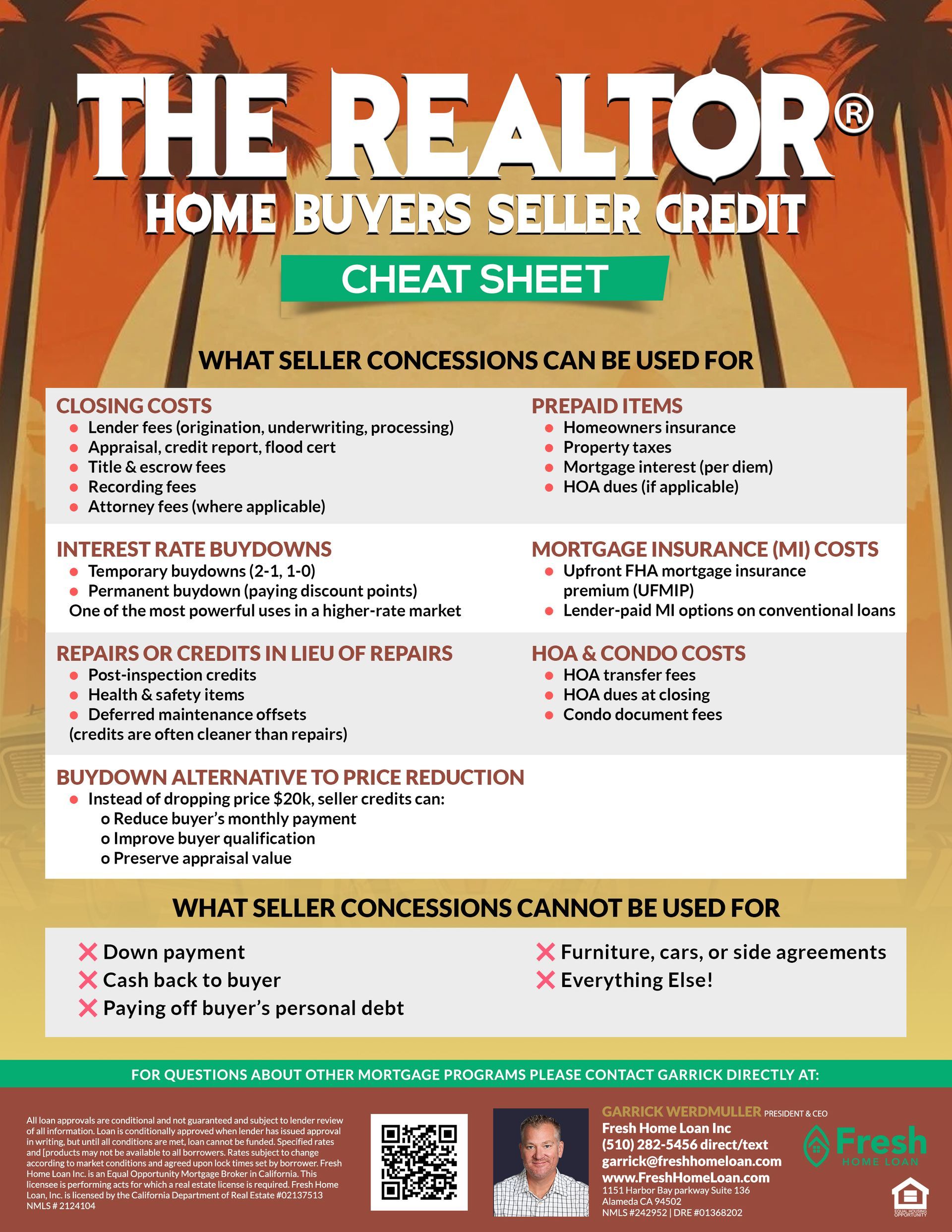
If you would like a copy of the Seller Credit Cheat Sheet or want to strategically structure your next offer:
Garrick Werdmuller
President & CEO
Fresh Home Loan Inc.
(510) 282-5456
garrick@freshhomeloan.com
www.FreshHomeLoan.com
All loan approvals are conditional and not guaranteed and subject to lender review of all information. Loan is conditionally approved when lender has issued approval in writing, but until all conditions are met, loan cannot be funded. Specified rates and [products may not be available to all borrowers. Rates subject to change according to market conditions and agreed upon lock times set by borrower. Fresh Home Loan Inc. is an Equal Opportunity Mortgage Broker in California. This licensee is performing acts for which a real estate license is required. Fresh Home Loan, Inc. is licensed by the California Department of Real Estate #02137513 NMLS # 2124104
#SellerCreditsStrategy
#SmartHomeOffers
#RealEstateFinancing
#CaliforniaHomes
#RateBuydownTips
#MortgagePlanning
#HomePurchase
#FirstTimeBuyerSupport
#FreshHomeLoan
#CaliforniaLiving